What is an X-Wing in Sudoku?
An X-Wing is four positions for one candidate aligned in two rows and the same two columns, or the column-first equivalent.
Sudoku Challenges
Advanced technique
If one candidate appears in exactly two matching columns across two rows, the four positions form a rectangle and clear that candidate from the rest of those columns.
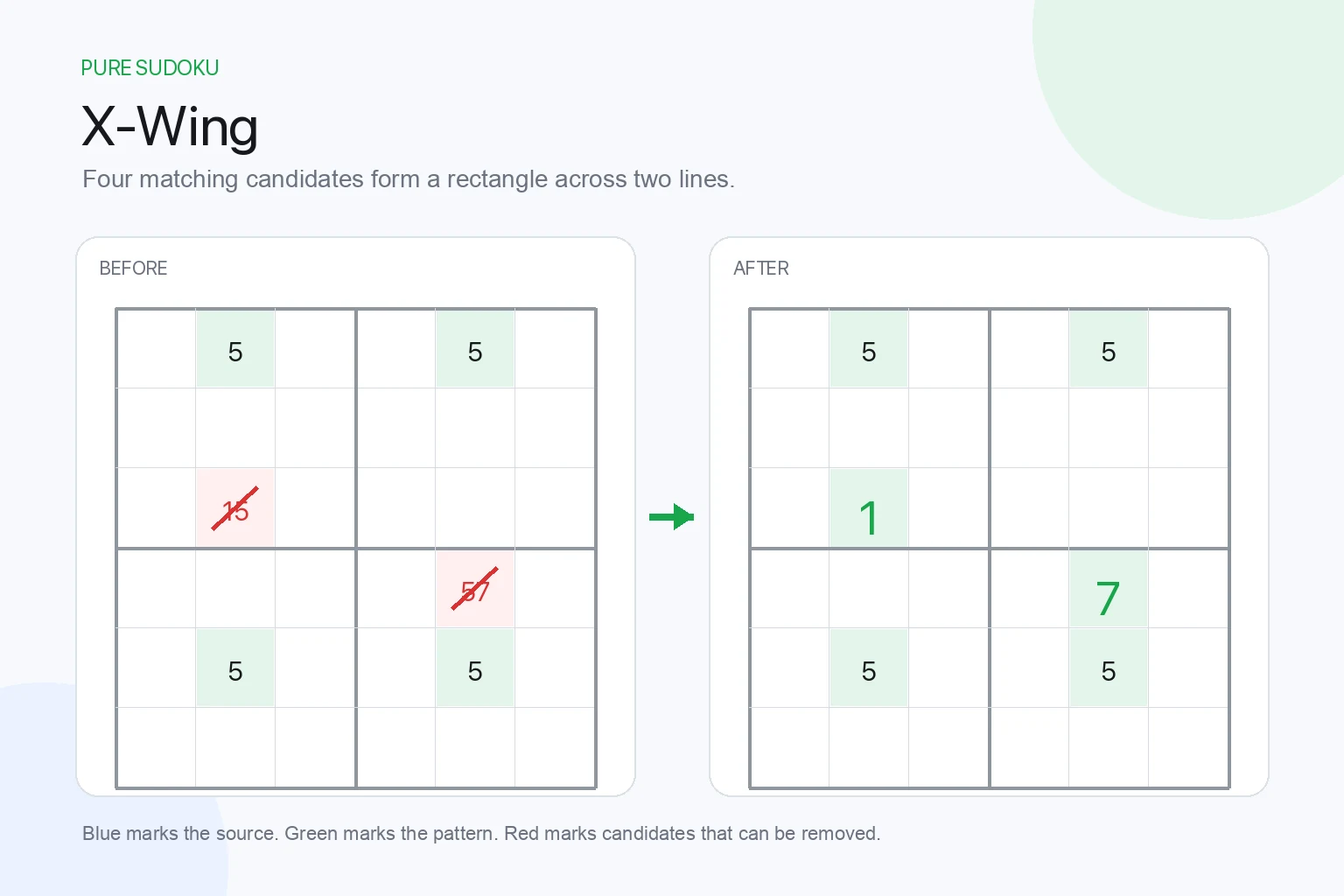
Focused example
The highlighted cells show the exact scope of the pattern. Read the candidates before making an elimination.
How it works
Know the difference
A pair operates inside one unit. X-Wing links two rows with two columns, so the elimination occurs outside the four corner cells.
After the move, re-scan the affected unit for singles before searching for another advanced pattern.
Common mistake
Each selected row must restrict the candidate to the same two columns. Extra candidate positions in either row break the X-Wing.
If any required condition is missing, leave the candidates in place and continue scanning.
Continue playing
FAQ
An X-Wing is four positions for one candidate aligned in two rows and the same two columns, or the column-first equivalent.
It removes the candidate from other cells in the two intersecting columns or rows.
No. Use it only when the exact four-corner restriction appears.
Practice loop
Pause when the board slows down, check the candidate conditions, make one justified move, and scan again.