Medium Sudoku
A standard board for steady practice with scanning and candidate notes.
Open this puzzleA puzzle for your kind of break
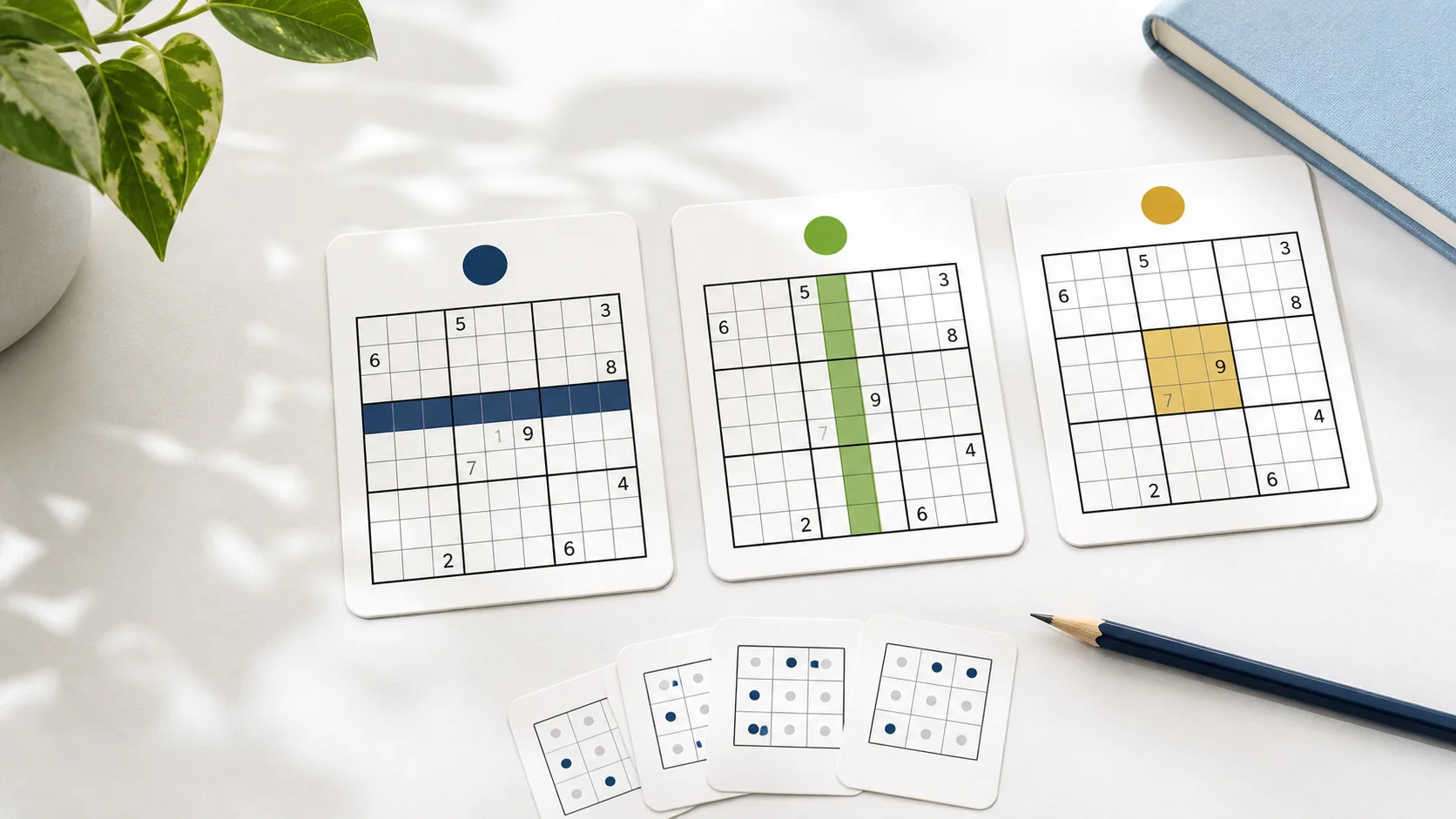
Choose the constraint you want to explore. Classic Sudoku is about placing symbols; Killer adds cage totals; Diagonal adds two more units to check. These are playable Sudoku formats, each with a different reason to pause and think.
Choose a puzzle
A standard board for steady practice with scanning and candidate notes.
Open this puzzleUse the cage total and the no-repeat cage rule alongside rows, columns, and boxes.
Open this puzzleEach of the two main diagonals must also contain 1 through 9 once.
Open this puzzleTrack symbols 1 through 16 in rows, columns, and 4×4 boxes on a larger board.
Open this puzzle| Format | Rule beyond classic 9×9 | A useful first check |
|---|---|---|
| Classic | None | Find a cell or unit with one missing possibility. |
| Killer | Cage sums; no repeated digit inside a cage | Work out which digit combinations can make a small cage total. |
| Diagonal | Both main diagonals are additional units | Include diagonal peers when checking a highlighted cell. |
| 16×16 | Sixteen symbols and 4×4 boxes | List missing symbols carefully before making placements. |
When a row is missing 2 and 7, check the two empty cells against their columns and boxes. If one cell shares a column with a 7, it cannot be 7; the remaining 2 is forced. That is the central habit across these formats: name the rule that removes an option.
If you know classic Sudoku, Diagonal is a direct way to add another unit to your scans. Killer is a different exercise because you track combinations as well as candidates. The 16×16 format changes the scale of the board rather than introducing cage arithmetic.
For descriptions of other puzzle families such as Kakuro, nonograms, and logic grids, use the Games Like Sudoku comparison. This page focuses on the Sudoku formats you can play here, so you can compare a rule and immediately try it.
You can play classic Sudoku, Killer Sudoku, Diagonal Sudoku, and a 16×16 Sudoku starter on the linked pages.
Killer adds cage sums and a no-repeat rule inside cages. Diagonal keeps the standard grid and requires each main diagonal to contain 1 through 9 once.
The linked Killer, Diagonal, and 16×16 pages use fixed starter puzzles. Use standard solo Sudoku when you want a freshly generated board.